Friday, September 24, 2010

Intermodal Shipping Containers


For quite some time I've been fascinated by intermodal containers. This fascination began through observing these units traveling on rails or by truck, a versatility that appeals to me. They are also so standardized, uniform in nature. I also for some time enjoyed collecting models of truck and trailers manufactured by a model train company. These containers can be stacked and configured in such a wide variety, creating an ever changing environment and landscape.

I'm also drawn to the strength and solidity of these units. Built of steel to withstand the tests of shipping and protecting its contents, everything about them is designed for heavy use. I find the door design appealing in terms of the large hinge assemblies and latch configurations.

These intermodal units also hearken back to the wooden crate. These containers act as storage and also as a way to transport objects in a more efficient and safe manner. The logistics of operating a seaport, with imports and export flows, is not only complex but is truly made possible by these interchangeable containers.


Saturday, September 18, 2010

Railroad Noise Machine


One of my most recent inventions is a noise machine. As part of being enrolled in sculpture this fall, I became part of a noise collective. What I brought to the group is a machine inspired by industry, incorporating a lever, pulley, and other simple devices which create clanking, grinding etc when operated. Like any machine, this one requires repair and maintenance on a regular basis. Springs become detached, wires break; these connections require adjustments and such. The piece brings in actual, used railroad parts, along with other simple materials.

Wednesday, September 15, 2010

This Old Barn


I've always been fascinated by old wooden structures. Those who are familiar with my art readily think of my railroad trestle work. While a major theme and interest of mine, it is not the only thing I consider in the broader perspective. I enjoy structures in each stage of their life, from the pristine to the decaying. Although there is a sense of loss and regret in seeing an old structure like this fall to ruin, there is a strange beauty which emerges. It is as if that structure, built from natural materials, is even closer to nature.

I feel that very soon I'll embark on a series of barns. One of my recent, ongoing ceramic pieces considers the idea of creating a scene of an old, wood-built warehouse, a harbor scene. It is this sense of commonality which I seek after; the pieces I create are from a similar era. They are industrial and agricultural in nature. Each barn, bridge, or other structure, while fulfilling a similar purpose, is each unique. That is, within each category, the variety is staggering. Like human beings, no two barns are exactly alike. The same goes for railroad trestles and so on. Each carries with them a very specific, personal history. It is as if each has a life of its own, from birth (construction) to death (decay-demolition-return to nature). Each structure influences and transforms its environment, creating a unique viewing experience.

Wednesday, September 8, 2010

History of the Rails


I have lived by the railroad my whole life and decided to do a little investigating about its past. I uncovered some photos from past days. Locomotive 758, pictured on the trestle, has long been retired. Yet, up until a few years ago, that bridge was still in use. This wooden structure surpassed the 100-year mark. It has since been replaced by a steel and concrete trestle. It's quite interesting the long life-span of the old trestle; it saw all three of this freight trains representing the three last eras, plus older trains as well. In fact, the wood trestle was original to the railroad at completion at the end of the 19th century.

These are all images from the locality in which I was raised.

This reinforces my focus on industrial structures which reside in our landscape. Industrial forms contrasted with nature must be well built in order to withstand the elements. Eventually, the wood decayed to the point that it could no longer support the heavy loads. The steel is subject to rust and will unlikely have a useful life near that of wood.

In thinking about the utilitarian purpose of these structures, there is an inherent beauty and simplicity in the message. It goes deeper however to include such readings as a sorrow for man's interference in the natural landscape, as evidenced by mines and logging when conducted in an unsustainable manner. For me, these forms are dealing with all things that are truly about our existence and things with which we interact. That does not mean they need be dominant; rather, they simply exist and fulfill some kind of purpose. Beyond the utilitarian, they can help us to understand the world in which we reside and the temporal nature of things in contrast to seemingly indestructible materials.

Sunday, September 5, 2010

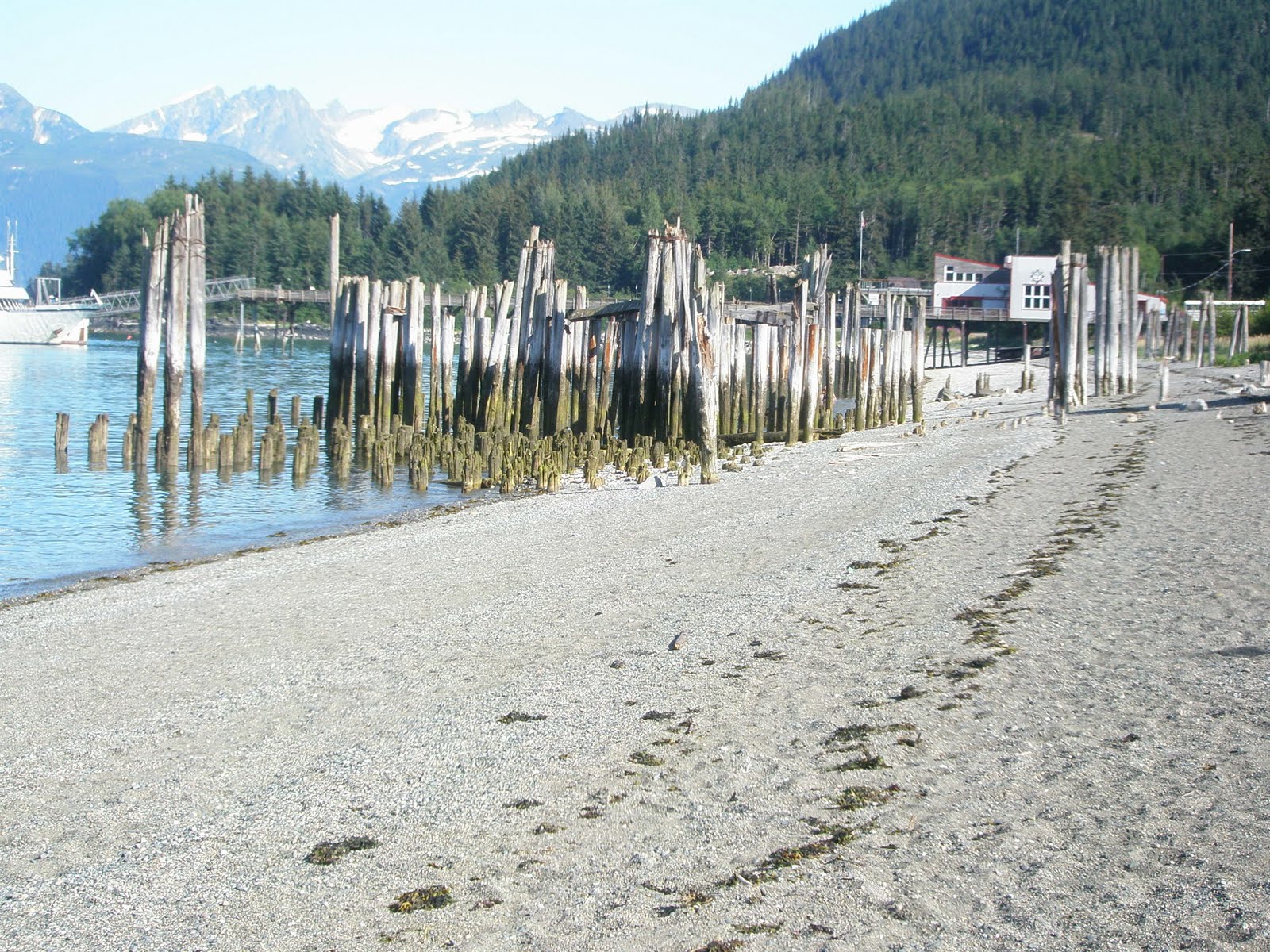
Haines, Alaska


I enjoy some of the simplier things in our landscape, the often overlooked elements such as an old pier. I've been drawn to harbor settings perhaps for this very reason, along with other wooden structures like barns, sheds, and older bridges. There seems to be a quality built into these structures of the past.