After looking through his writings I got a very vivid picture of his art practice and how, rather than being studio practice, it is social practice where he allows himself the freedom to do work that is not so tied to the commercial art world. Some of the things that really stood out to me, and obviously did to him, was an undergraduate class he was in. The first day the class was told to pick an outdoor physical activity to do during class time for the rest of the semester. Harrel decided to walk on railroad tracks and became very good at it by the time they met together at the end of the semester. Of all the classes he took, he remembers this one better than all the lectures, exams, assignments, and discussions that were part of his other classes.
I was also impressed by what he said about teaching; "Most of what I do as an art professor now is based not my art education but instead on my farming education."Harrel spent some time doing a farm apprenticeship following graduate school which turned into a very important learning experience. I'm also reminded of something he mentions, which we also discussed in sculpture class last semester. The basic premise is that our education system is not set up for teaching as well as it could be. I find there to be solid logic behind this and agree with his philosophy in many ways.
Wednesday, February 2, 2011

Tuesday, January 18, 2011
Steel Brackets and Architectural Space

 For some reason or another, I am drawn to heavy duty, well built or even overbuilt construction. I think part of it may be that I get a sense of satisfaction out of something that's durable and made to last; also, I'm not interested in going at length through all the necessary calculations so as to minimize the amount of strength required. As a precaution and so as to reduce risk of failure, I aim toward the other extreme. There are times though when a project of mine does not have quite the durability that I had expected. In situations like that, the piece will exist in a more fragile state, but should function be an important factor, I seek out a way to reinforce the piece and make it stronger. I use this word loosely. When I talk about strength, I'm thinking of it in terms of implied in addition to the physical characteristics and ability to withstand force. When reinforcing the piece is not an option, I look for a way to protect the piece during storage and transport, as in a crate or space in which the object can reside.
I'm thinking of these things in relation to my sculptures and also in terms of architectural space. In order to create an installation of my work, I'm considering how I might convert a traditional gallery space into an industrial setting, one set up like a warehouse/shipping yard. In that case, some of these industrial design elements can be infused in my work and in the units I create, sculptures in themselves, which replace the traditional white pedestal.


Wednesday, January 12, 2011


Tuesday, January 11, 2011


Tuesday, November 9, 2010
Art in Relation to Crates

 In terms of building crates for works of art, there are some scale concerns that come to the forefront when the object is to be displayed with this container. The wood itself is "life-size," a 1 to 1 ratio to reality. The object itself may be a different scale, however. In my case, my sculptures are generally smaller than life size. This issue of a sculpture, sitting on a pallet or other wooden structure, in relation to this other object is something I'm still trying to figure out.
Let's say I place a clay trestle on a sheet of plywood, as I have done in the past. There are two contrasting scales at work (unless of course the trestle fills a museum or the plywood is "miniature," a word I hesitate to use.) Changing these variables completely alters the context. One variable I have considered is the plywood or other type of wooden base. I've asked myself if that should be the same scale as the piece. I also wonder if it is something with which I should concern myself, since I'm very much interested in this idea of transportation and moving of objects or goods. The crates I build seem to naturally fit within our expectations, as seen in these well built shipping crates at the Walla Walla Foundry. These are fulfilling a utilitarian use separate from the object. I'm seeking to merge the two.
One reason I feel this is important to address centers around the sculpture in relation to other objects. If the objects around the sculpture are smaller, the sculpture will naturally appear larger. By the same token, if the crate I build seems to large for the piece, the sculpture will feel smaller. My ceramic pieces shrink significantly through the process of making, shrinking anywhere from 10 to 15 percent of it's original size by the time it comes out of the final firing. Size and scale inherently go along with this material.


Monday, October 18, 2010
Walla Walla Foundry Facilities Tour

 I recently had the opportunity to tour the Walla Walla Foundry. I had been hoping to visit this place for some time, and I was excited when the opportunity arose. My visit did not disappoint. Mark Anderson, President, devoted a couple hours to the group of us from WSU, generously spending his time to help us understand what takes place at the foundry. From my limited experience working through the casting process, I can appreciate the great deal of time, skill, and problem solving that goes into creating these sculptures.
The facilities were impressive, as were the individuals on hand to keep the place running. It is a fascinating place from an operations standpoint, as well as from the viewpoint of an artist. Internationally recognized and well established artists work with and depend upon the expertise at the foundry in order to realize their projects.
I've come away from this experience with some ideas in mind of how I might apply new techniques to my own working process. The equipment and buildings in this industrial setting were inspiring to me in themselves. A visit to the foundry was a great glimpse into the art world and the working process behind creating sculptures. They make use of some advanced forms of technology, facilitating the process of creating complex and large scale forms. It gives me much to consider, especially as I think about the scale of my own work.


Thursday, October 7, 2010
Warehouse in-progress


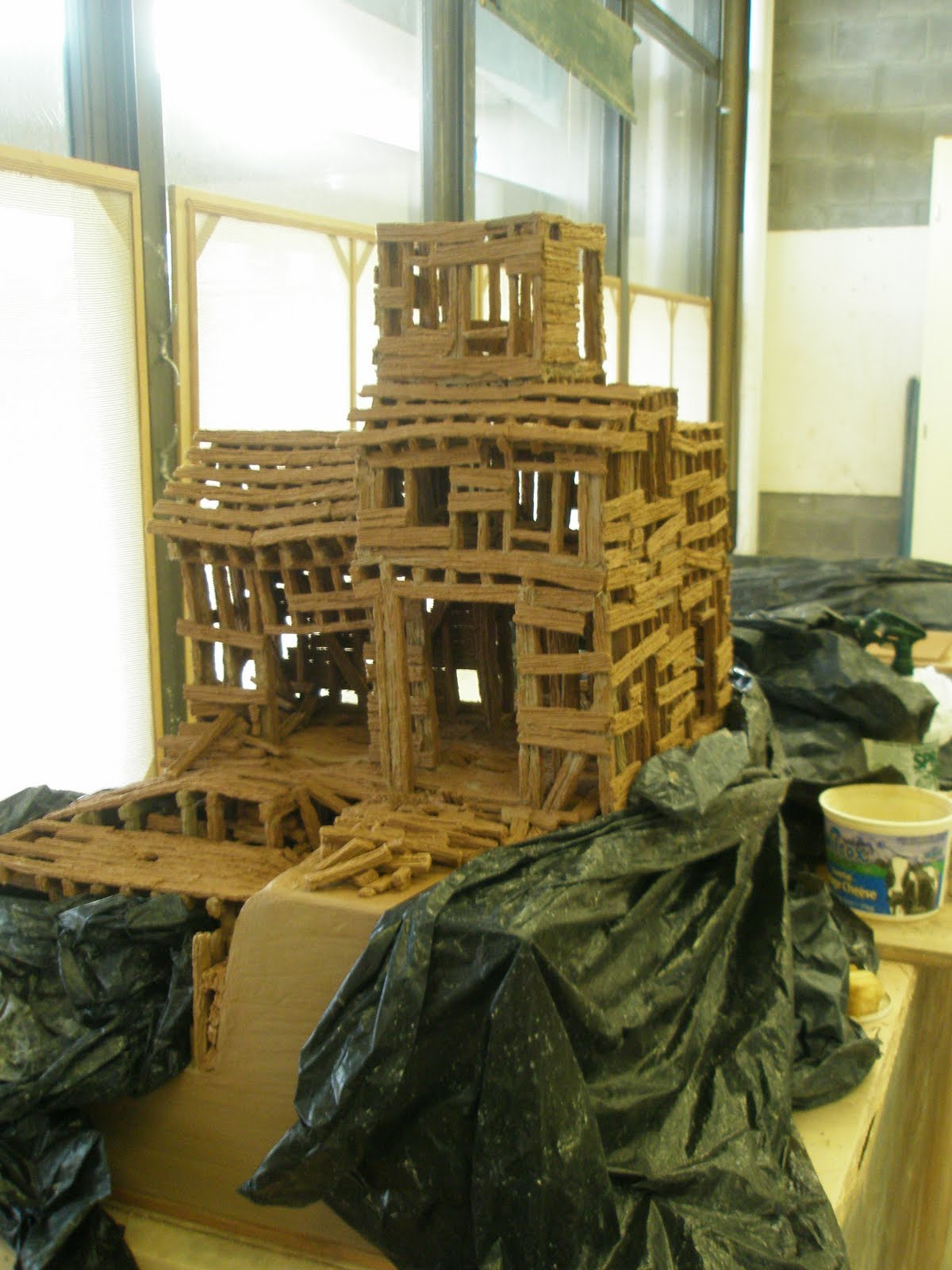 Right now in my work I'm seeking to expand my subject matter. It has been a couple years since I've explored some of these subjects in clay, so I felt it is time to revisit and push some of these ideas forward. This new series will involve rustic, abandoned buildings such as warehouses and barns. Some may be in various life stages, from more modern all the way to the scrap stage. Color choice is also an important consideration in addition to the form. These are structures which I envision, and I often look at reference images for inspiration. More of a matte, earth tone finish will be applied to this piece and likely all in this series.
Wednesday, September 29, 2010
Wooden Crates

 There is an aesthetic of a wooden crate which is appealing. Although sometimes associated directly with the past, they are still utilized regularly for transporting and storing large, heavy, and/or heavy pieces.
For me, they serve this purpose in my sculptural work as well as an extension of the piece itself. They also seem to me as a means to overcome the pedestal. Although I have yet to work through all of these issues, there is the possibility of displaying pieces on top of these crates or in positions of being removed from such a container. Certain pieces may even be displayed within a crate, depending on the specific installation.
The crate pictured on the red hydraulic lift (at bottom) is one which I recently built. It sits 4 feet long, by about 2 feet wide and 2 feet tall. I've envisioned creating an environment in a gallery setting in which it is as if the viewer just walked into a shipping yard, warehouse, or other industrial seen. Although I very much approach my sculptures as objects, I'm interested in how they might interact together to create more of an installation. I've also gained a deeper respect and appreciation for the process not only of art making but also of transportation; I would like these aspects to be apparent in my work also. But again, most important, I'm drawn to this notion of environment or installation, moving beyond the object so as to give it a new identity.


Friday, September 24, 2010
Intermodal Shipping Containers

 For quite some time I've been fascinated by intermodal containers. This fascination began through observing these units traveling on rails or by truck, a versatility that appeals to me. They are also so standardized, uniform in nature. I also for some time enjoyed collecting models of truck and trailers manufactured by a model train company. These containers can be stacked and configured in such a wide variety, creating an ever changing environment and landscape.
I'm also drawn to the strength and solidity of these units. Built of steel to withstand the tests of shipping and protecting its contents, everything about them is designed for heavy use. I find the door design appealing in terms of the large hinge assemblies and latch configurations.
These intermodal units also hearken back to the wooden crate. These containers act as storage and also as a way to transport objects in a more efficient and safe manner. The logistics of operating a seaport, with imports and export flows, is not only complex but is truly made possible by these interchangeable containers.


Saturday, September 18, 2010
Railroad Noise Machine


One of my most recent inventions is a noise machine. As part of being enrolled in sculpture this fall, I became part of a noise collective. What I brought to the group is a machine inspired by industry, incorporating a lever, pulley, and other simple devices which create clanking, grinding etc when operated. Like any machine, this one requires repair and maintenance on a regular basis. Springs become detached, wires break; these connections require adjustments and such. The piece brings in actual, used railroad parts, along with other simple materials.
Subscribe to:
Posts (Atom)